Bedding Guides
Duvet Covers and Bed Skirts: A Practical Guide to Fit and Function
One layer protects what is inside the bed; another shapes what you see beneath it. Duvet covers and bed skirts work in different places, but choosing them well depends on the same practical questions: dimensions, material, construction, care, and how the bed is used.
A duvet cover and a bed skirt can both help a bed feel finished, yet they do entirely different jobs. The cover wraps around a duvet insert, shielding it from everyday contact and providing a changeable surface. The skirt hangs from the mattress or foundation to cover the gap between the bed and the floor. One is a working textile that is handled often; the other is a lower, mostly stationary layer with practical and visual purpose.
That distinction matters when comparing bedding. A cover that is difficult to fasten or too small for its insert can bunch and shift overnight. A skirt with the wrong drop may float above the floor, drag across it, or hang unevenly. The right choices are not simply a matter of color or taste. They begin with measurements and continue with the details that determine whether each item behaves well in daily use.
This guide explains how to assess duvet-cover materials, closures, internal ties, dimensions, and care, then measure for a bed skirt and understand drop length. The aim is a coordinated bed that works as well as it looks—without treating either layer as a decorative afterthought.
What a duvet cover does
A duvet cover is a removable fabric shell designed to enclose a duvet insert. It helps keep the insert cleaner by placing a washable layer between it and the sleeper, and it can change the bed’s color, texture, or pattern without replacing the insert itself. Many covers open along one edge, allowing the insert to be removed for laundering or for a seasonal change in style.
The cover is not the insert. The insert supplies most of the bed’s insulation and loft; the cover supplies the surface that touches the sleeper and takes the brunt of routine use. This separation can make bedding care more manageable, but only when the cover is correctly sized, secure around the insert, and compatible with the household’s washing routine.
Before choosing a cover, check what is included. A listing may describe a duvet cover alone, while the insert and other bedding are separate. Confirming this prevents confusion about what arrives and helps ensure the planned combination will fit.
Start with dimensions—not the label alone
Bed-size names such as queen and king offer a useful starting point, but they are not a substitute for checking measurements. Dimensions can vary among manufacturers and between regions. Inserts can also differ in loft, and a lofty insert may occupy more space inside a cover than a flatter one with the same stated width and length.
Measure the insert itself, rather than relying only on the mattress size. Then compare those figures with the cover’s finished dimensions. A cover that is significantly larger may leave the insert shifting inside, creating loose corners or uneven distribution. One that is too small can compress the filling, make the bed feel less even, and strain the seams or closure. A close match usually helps the insert sit more consistently within the shell.
It is also worth considering the mattress and bed setup. A deeper mattress, a mattress topper, or a preference for generous drape can affect how much of the duvet falls along the sides. The duvet’s finished appearance depends on the whole arrangement, not just the label on the insert.
- Record the insert’s width and length before shopping.
- Compare those measurements with the cover’s stated finished size.
- Consider the insert’s loft and whether it tends to shift or compress.
- Think about mattress depth and the amount of side coverage you prefer.
- Check whether the cover’s dimensions are listed in inches or another unit.
When specifications are incomplete, ask the seller or manufacturer to clarify the actual dimensions. A few minutes spent checking fit can prevent a cover from feeling slack or strained once the bed is made.
Fabric changes the feel and the routine
Material affects how a duvet cover feels against the skin, how it handles heat and moisture, how it drapes, and how much attention it requires after washing. There is no single best fabric for every sleeper or room. A good comparison starts with the qualities that matter in ordinary use: tactile preference, breathability, weight, care instructions, and how the material is expected to change over time.
Linen
Linen is known for a textured surface and a relaxed drape. It may feel crisp at first and soften with repeated washing, depending on its construction and finishing. Its naturally varied texture can make a bed look less formal, while the fabric’s weight and weave influence how it feels in a particular climate. Linen often wrinkles; that is part of its characteristic appearance, though it may not suit someone seeking a consistently smooth finish.
Cotton and cotton blends
Cotton covers come in a wide range of weaves and finishes, so the fiber name alone does not tell the whole story. Percale tends to have a crisp, matte feel, while sateen commonly has a smoother surface and a subtle sheen. Blends may combine characteristics of different fibers, but their feel and care depend on the specific composition. Look for the fiber content and construction rather than assuming that all cotton bedding behaves alike.
Blended and recycled-fiber fabrics
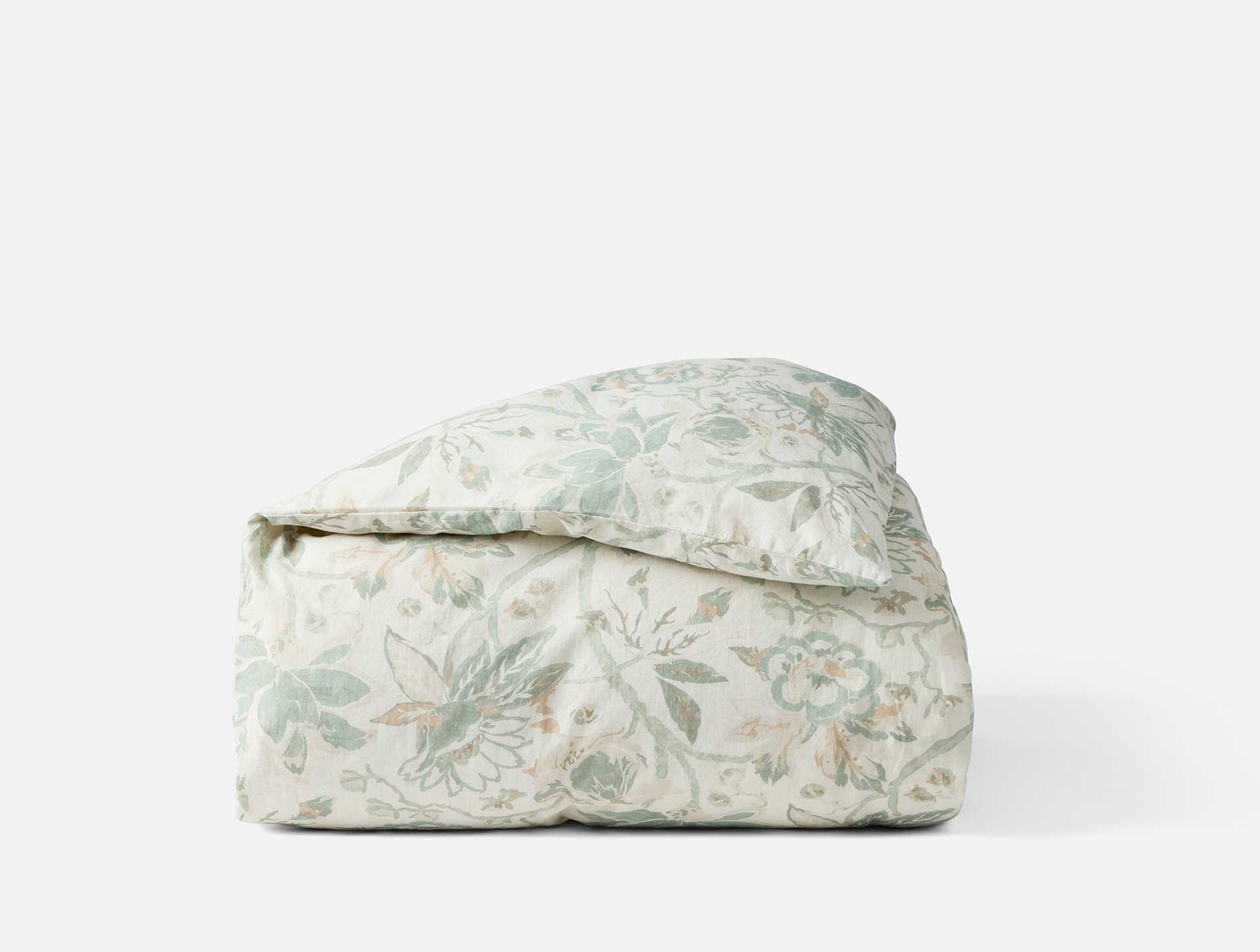
Some covers combine fibers to balance softness, texture, durability, or environmental considerations. For example, the Sea Bloom Print Duvet Cover is described as a blend of pre-consumer recycled linen and GOTS-certified organic cotton. Its construction includes internal ties and coconut shell button closures. Those details illustrate why a material comparison should look beyond the name of the fabric: composition, construction, fastening, and care instructions all contribute to the experience.
Certifications can provide information about particular production standards, but they do not answer every question about comfort, fit, or maintenance. Read them alongside the fiber breakdown, country or place of manufacture when provided, and the item’s care guidance.
Closures: small details with daily consequences
The opening of a duvet cover is more than a finishing detail. It determines how easily the insert can be put in, removed, and kept in place. Common closure types include buttons, zippers, snaps, and envelope-style openings. Each can work well when thoughtfully made and used with a compatible insert.
- Buttons can be straightforward to fasten and repair, though a long row may take time to close. Check that the button spacing is practical and that the closure lies comfortably at the foot of the bed.
- Zippers can close quickly and create a continuous opening, but their quality and placement matter. A zipper should move smoothly and be protected from snagging the insert or other bedding.
- Snaps provide a low-profile alternative to buttons. Their usefulness depends on secure attachment and whether they remain fastened during ordinary movement.
- Envelope openings rely on overlapping fabric rather than a row of fasteners. They can look simple, but the overlap must be generous enough to keep the insert enclosed.
Consider the way the bed is made and washed. A cover that is laundered frequently should be easy to open and close repeatedly. For a large duvet, an opening that allows the insert to slide in without excessive pulling can make changing the bedding less cumbersome. Examine the closure’s position, construction, and care requirements, especially if the cover has delicate decorative details.
Why internal ties help
Internal ties are small fabric fasteners, usually positioned near the inside corners of a duvet cover. They attach to loops on a compatible insert and help stop it from migrating as the bed is used. Some covers include ties at all four corners; others may use additional points along the sides. The exact arrangement varies, so check the product description and inspect the insert for matching loops.
Ties do not correct a substantial size mismatch, but they can reduce twisting and bunching when the cover and insert are close in dimension. To use them, turn the cover inside out, secure each tie to the corresponding insert loop, and then turn the cover right side out while guiding the insert into position. A gentle shake can help distribute the fill before closing the opening.
If the insert has no loops, ties may still be manageable with a method suitable for its construction, but avoid attaching them in a way that could damage the shell. The goal is to keep layers aligned, not to pull tightly enough to distort the fabric. After laundering, check that ties remain securely attached and that no fastener has twisted around a corner.
Care begins with the label
Care instructions are part of the decision, not a footnote to read after purchase. A cover may call for cold washing on a gentle cycle, like colors, low-heat drying, prompt removal from the dryer, or ironing at a specified temperature. Follow the care label for the particular item; do not assume that two covers made from similar fibers can be treated identically.
Before washing, close buttons or zippers where the care guidance permits and secure loose ties. This can reduce tangling and help protect the closure. Avoid overloading the washer, since a large cover needs room to move and rinse. Drying thoroughly is important before the cover is stored or put back on the insert. If the item has embroidery, contrast panels, or distinctive fasteners, take extra care to protect those features as directed.
Regular washing frequency depends on use, household preferences, and whether a top sheet is used. The cover is removable precisely because it can be cleaned more easily than many inserts, but repeated washing still places stress on fabric and seams. Choosing a cover whose routine care fits your habits makes it more likely to remain useful over time.
What a bed skirt is—and what it is not
A bed skirt is a textile panel that hangs from the mattress or foundation around the base of the bed. It can conceal a box spring, frame, legs, or items stored underneath, and it creates a visual boundary between the bed and the floor. Depending on the fabric, color, and construction, it can make the bed appear tailored, informal, rustic, or quietly understated.
It is not a substitute for storage organization or a fitted sheet, and it does not automatically eliminate dust beneath a bed. A skirt can help screen the area from view, but the space still needs routine cleaning. Its practical value lies in covering the exposed base and helping the bed look composed, while its decorative effect depends on how well it fits the frame and coordinates with the other layers.
Bed skirts are made in different styles and materials. A tailored skirt tends to create straighter lines, while a more gathered design can look softer and fuller. Some are lined; others are not. The fabric’s weight affects how it hangs, and the construction can influence how easily it is installed and kept even around the bed.
How to measure bed-skirt drop length
The bed-skirt drop is the vertical distance from the top of the foundation or the point where the skirt rests to the floor. Measuring this distance is essential: a skirt with too short a drop may leave the frame visible, while one that is too long can pool, drag, or catch underfoot. A neat fit generally allows the panel to hang close to the floor without resting heavily on it, though the preferred look varies.
Measure with the mattress and any topper in place, then identify where the skirt’s deck—the fabric panel that lies across the foundation—will sit. Measure vertically from that point to the floor at several locations. Floors and frames are not always perfectly level, so checking more than one side or corner can reveal differences. Use the longest or most representative measurement according to the style and construction of the skirt, and compare it with the manufacturer’s stated drop.
- Make the bed with the mattress and topper in their normal positions.
- Identify the level at which the bed skirt will sit on the foundation.
- Measure straight down to the floor at the sides and foot of the bed.
- Record the measurements and compare them with the skirt’s stated drop.
- Consider whether a small clearance above the floor will work better than a panel that drags.
For instance, a bed skirt described with an 18-inch drop should be compared with the actual vertical distance on the bed, not simply selected because the mattress is a particular size. The Bovi Hudson Linen Bed Skirt is described as fully lined and tailored, with an 18-inch drop. Its listed materials and dimensions offer useful information for comparison, but the measurement should still be checked against the intended bed.
Account for the frame and mattress setup
Bed height is the combined result of the frame, foundation, mattress, and any topper. Changing one component can alter the visible gap below the mattress and the way a skirt hangs. Adjustable bed bases introduce another consideration: the base may change position, and any surrounding frame or support structure may affect how a skirt can be attached and whether it remains aligned during movement.
Before selecting a skirt for an adjustable setup, check the base manufacturer’s guidance and the skirt’s construction. A traditional skirt may rely on a platform that sits beneath the mattress, which might not suit every moving base. A panel that hangs near mechanical components or moving sections could interfere with operation. Compatibility should be established from the equipment and textile specifications rather than assumed from bed size alone.
Also consider access. If under-bed storage is used frequently, a full-length skirt may need to be lifted or moved each time. If the bed is rarely adjusted and storage is occasional, a more continuous drape may be convenient. The ideal choice balances appearance with the routines that take place around the bed.
Coordinating covers and skirts without overmatching
A coordinated bed does not require every textile to be identical. The duvet cover usually occupies the most visible area, while the bed skirt sits lower and often appears only as a border. They can relate through color, texture, or mood without sharing the same print or material. A solid skirt can quiet a patterned cover; a textured skirt can add depth beneath simple bedding.
Think in terms of proportion. A bold duvet pattern may need a calmer base so the bed does not feel visually crowded. Conversely, a restrained cover can leave room for a skirt with a distinctive texture or color. The room’s floor, wall color, bed frame, and other textiles also influence the result. Samples or swatches, when available, can help compare undertones under the room’s actual lighting.
Practicality should remain part of the aesthetic decision. A pale skirt may show marks more readily near the floor, while a delicate cover may need more careful laundering. A coordinated look lasts longer when each piece suits the way the room is used and can be maintained without unusual effort.
Common fit problems and how to prevent them
The insert bunches inside the cover
Check whether the dimensions are compatible and whether internal ties are attached to the insert’s loops. Redistribute the fill after fastening. If the insert is much smaller than the shell, ties may not fully solve the problem; a closer size match is the better remedy.
The duvet feels compressed
A cover that is too small can restrict the insert’s loft. Confirm the finished dimensions and allow for the insert’s thickness. Do not stretch seams or closures to force an unsuitable combination into place.
The bed skirt drags or floats
Recheck the vertical measurement from the skirt’s resting point to the floor. Confirm that the skirt has not shifted on the foundation and that the mattress or topper has not changed the deck’s position. If the floor is uneven, a perfectly identical gap on every side may not be possible.
The skirt sits unevenly
Center the deck and make sure the mattress is positioned consistently. On a split foundation or adjustable base, inspect how the skirt is supported and whether the construction allows it to remain in place during movement.
A concise checklist before choosing
- For a duvet cover: verify the insert’s dimensions, compare the finished cover size, and account for loft.
- For fabric: consider feel, weight, texture, breathability, and how the material may change with washing.
- For closure: choose a fastening you can use comfortably and check its location and construction.
- For internal ties: confirm their number and placement, and look for compatible loops on the insert.
- For care: read the item-specific instructions and decide whether they fit your routine.
- For a bed skirt: measure drop length from the intended resting point to the floor.
- For the whole setup: account for the frame, foundation, mattress, topper, storage needs, and any adjustability.
The useful difference between the two layers
Duvet covers and bed skirts solve separate problems. The cover protects an insert, keeps the bed’s surface changeable, and must be sized and fastened to work with what it encloses. The skirt frames the base, hides what lies beneath, and depends on a precise relationship between bed height and drop length. Confusing their roles can lead to choices based on appearance alone; understanding them makes comparison more direct.
Start with measurements, then consider material, construction, and care. Check closures and ties on a duvet cover; measure the skirt’s drop against the real bed rather than a size label. Finally, judge the two layers together in the context of the room and its daily routines. The result need not be elaborate. A well-fitting cover and a correctly measured skirt can bring order to the bed in ways that are felt in use as much as seen in the room.