Bedroom Setup Guide
Choosing an Adjustable Bed Base: Features, Fit, and Everyday Use
An adjustable bed base can turn a flat sleeping surface into a more flexible place to read, rest, or settle in for the night. The useful question is not how many buttons a base has, but whether its movements, dimensions, and setup suit the way a bedroom is actually used.
A practical guide to adjustable bed features, mattress and frame compatibility, room planning, and daily routines.
A bed that moves with the day
A conventional bed offers one main position: level. An adjustable base adds movement, typically allowing the head, feet, or both to rise and lower. That change can make a bed more accommodating during waking hours, when someone might want to sit up to read, watch a program, or use a laptop. It also allows sleepers to experiment with different positions as part of their nighttime routine.
The hardware is only half the decision. A base has to fit the mattress, the room, and—if one is being used—the existing bed frame. It must also leave workable access to outlets and controls. A feature-rich model that crowds a narrow room or conflicts with the mattress can be less useful than a simpler base that fits naturally.
Start with the daily pattern. Is the main goal to raise the head for reading? Is independent adjustment important for two people sharing a bed? Would under-bed lighting help with nighttime movement? These questions translate a list of specifications into a short, practical set of priorities.
What the main adjustments do
Independent head and foot movement
Many adjustable bed bases let the head and foot sections move separately. Raising the head creates a reclined position; lifting the feet changes the angle of the lower body. Moving both sections can produce a gently curved posture, though the exact range and shape differ by model.
Independent movement offers more choice than a single hinge or one-piece incline. It can be handy for switching between activities: a slight head lift for reading, a flatter position for sleep, or a temporary adjustment to find a comfortable resting posture. The important distinction is between having many possible positions and finding a few that genuinely earn a place in everyday use.
Head tilt and other articulation
Some bases add a separate head or neck tilt beyond the main head elevation. This adjustment can provide a more finely tuned upper-body angle for reading or screen use. It also introduces another moving section, so check that the mattress is designed to flex with it and that the control layout makes the feature straightforward to operate.
A base with additional articulation is not automatically a better match. The added movement is most valuable when it answers a specific preference. If the bed will mostly remain flat, extra adjustment may bring complexity without much practical benefit.
Presets and memory positions
Presets can move a base into a programmed position with one command. Common labels include “TV,” “zero gravity,” “anti-snore,” and “flat,” but names are not guarantees of a particular sensation or health outcome. The actual position depends on the base’s design and settings. Treat presets as convenient starting points rather than promises.
Memory settings let a user save a preferred arrangement. For a routine that repeats—such as sitting up before sleep or returning to a favored recline—this can reduce fiddling with separate controls. A “flat” or “go flat” button is especially useful when it returns the bed to a level position without requiring several adjustments.
Massage, lighting, and charging
Some bases include vibration or massage functions, often with different intensities, zones, or timers. These are comfort features, not medical treatments. Consider whether the controls are intuitive and whether the feature can be switched off quickly. In a shared bed, separate controls for head and foot zones may matter; in a quiet bedroom, motor and vibration noise deserve attention.
Under-bed lighting can help make the floor visible when getting up at night. Its usefulness depends on brightness, placement, and whether it can be turned off without lighting the whole room. USB ports can keep a device within reach, though they should not turn the bed into a reason to stay on a screen late into the night. Convenience is best when it supports a routine rather than dictating one.
Wireless remotes are common, while some systems also connect to a phone or tablet. App control may be appealing, but a physical remote can be easier to find and use in the dark. Check how the base behaves if a phone is unavailable, a battery runs low, or a connection is interrupted.
Begin with mattress compatibility
An adjustable base bends at designated points, so the mattress must be able to flex without damage or uncomfortable bunching. Foam, latex, and many hybrid mattresses are designed to work with adjustable foundations, but construction varies. A mattress that is too rigid, has a frame or internal component that resists bending, or is not approved for articulation may not perform as intended.
Before choosing a base, consult the mattress manufacturer’s current guidance. Confirm whether the mattress can be used on an adjustable foundation, what positions are permitted, and whether using one affects the warranty. Do not assume that two mattresses made from similar materials have identical flexibility.
Also check the mattress’s dimensions and weight. The base should be the correct size, and its stated capacity must account for the mattress and the people using it, as well as bedding and any other load the manufacturer includes in its calculation. Capacity limits are not a measure of comfort, but they are an essential safety and durability check.
For split configurations, the bed may use two independently moving sections side by side. This can let each person choose a different angle, but the arrangement needs a compatible mattress setup and enough room for the two bases. Confirm the exact size terminology: a split king, for example, is commonly made from two Twin XL sections, but dimensions and configurations should be verified with the manufacturer.
Will it work with the existing frame?
“Adjustable” does not mean “fits every bed frame.” Some bases are designed to sit inside or on top of a compatible platform or pedestal frame; others may be used on a foundation or directly on the floor, within the manufacturer’s instructions. Compatibility depends on the base’s footprint, support points, clearance, and the way the outer frame is built.
Measure the interior of the existing frame, not just the mattress. Note any center rails, crossbars, slats, drawers, or decorative panels that could obstruct movement. A base needs room to articulate, and a fixed rail or low headboard can interfere even if the mattress appears to fit. Ask whether the base is intended to be used inside that particular frame and whether its legs or supports can be configured accordingly.
Headboards and footboards need separate consideration. The moving surface may shift relative to the wall or surrounding furniture. A wall-hugging design is intended to move the sleeping surface in a way that helps keep the user near a bedside table, but the result depends on the base and room layout. Do not assume that every adjustable model maintains the same position beside a nightstand.
For a freestanding bed, stability and floor protection matter. Check that all feet sit securely on the floor, that the surface is suitable for the base’s weight, and that rugs or uneven flooring will not create wobble. Follow the maker’s assembly and placement directions rather than improvising support under the legs.
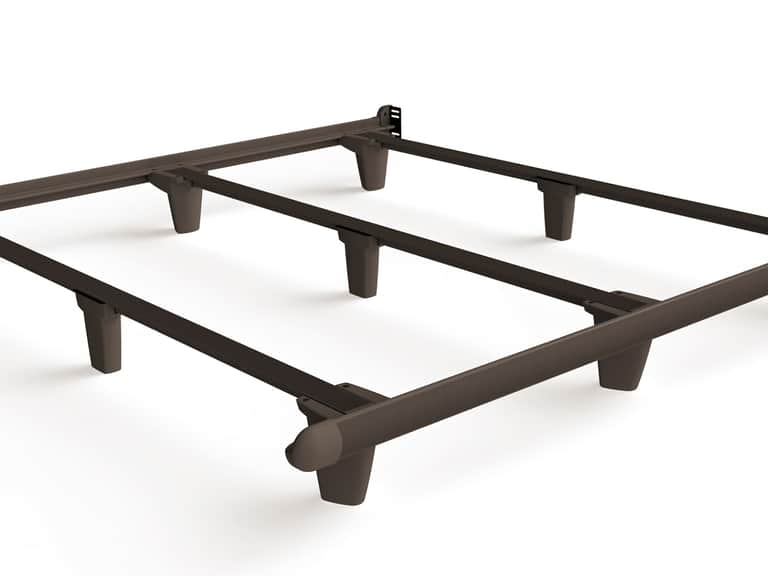
A conventional bed frame may still be useful as an outer surround, but an adjustable base is not the same thing as a standard platform frame. For example, the emBrace Designer Foundation Frame by Knickerbocker is a foundation frame; whether it can be combined with a particular adjustable base depends on the specified arrangement. Check compatibility before planning a layered setup.
Measure the room, not just the mattress
The stated mattress size describes the sleeping surface, not the entire footprint of the setup. Legs, mechanisms, cables, and an outer bed frame can add to the dimensions. Measure the room and the route the base must travel to reach it: doorways, stair turns, hallways, elevators, and tight corners can complicate delivery and assembly.
Leave practical clearance around the bed. Users need space to get in and out, reach controls, open closet doors, and move through the room. Check whether drawers or storage bins under the bed will remain accessible. Some bases have moving parts or a broad frame that makes under-bed storage awkward, even if the bed looks compact when flat.
Height can change the feel of the room as well as the ease of getting into bed. Include the base legs, the base itself, the mattress, and any topper when estimating the final sleeping height. A surface that is too high or too low may be inconvenient for someone’s mobility or for the height of nearby furniture. If the base has adjustable legs, verify the range and how that range is achieved.
Product dimensions can be presented in different ways. A model might list its footprint, platform height, or height with legs in more than one position. Read the measurement labels carefully and compare like with like. When details are unclear, confirm them before arranging delivery or removing an existing frame.
Plan for power and controls
Motorized movement requires a power source. Identify the nearest outlet and check that the cord can reach without running across a walkway or being pinched by furniture. Avoid relying on an extension cord unless the manufacturer explicitly allows it. If outlets are limited, decide whether a lamp, charger, or other device will need to move.
Think through the position of the remote before assembly. A wireless remote should be easy to locate from the bed, and its buttons should be distinguishable without having to study them in bright light. If the model includes an app, consider who will use it and whether a physical control remains available. Child locks or other lockout functions can be useful where accidental activation is a concern.
Motors make some sound, and movement can be noticeable to a person sharing the bed. If noise sensitivity is important, seek reliable information about operation and warranty support rather than assuming all models are silent. Similarly, check whether vibration features can be run independently and whether a timer prevents them from continuing longer than intended.
A real-world example of feature trade-offs
Product specifications can make comparison concrete, provided they are treated as examples rather than universal standards. The Clean Bedroom Level 3 Adjustable Bed Base, for instance, lists independent head and foot lift, a head-tilt feature, massage controls, presets, USB ports, under-bed lighting, and adjustable leg heights. Those details help illustrate the range of functions found on a more articulated base. Whether they matter depends on the household’s routine and the compatibility of the mattress and frame.
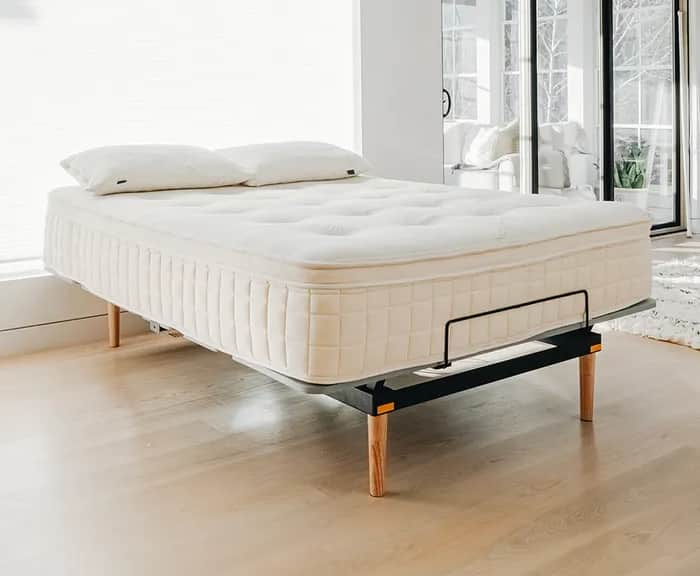
The Naturepedic Conductor Adjustable Bed Frame is another example of a base with head and foot movement, memory positions, a wireless remote, app connectivity, under-bed lighting, and a wall-hugger design. Its published specifications include adjustable platform height and size-specific weight capacities. Such figures are useful starting points, but should be checked against current manufacturer information and the exact configuration being considered.
Neither list answers the most personal question: what would be used regularly? If a sleeper mainly wants to elevate the head for a few minutes of reading, a separate head tilt, app control, and several massage modes may not be priorities. If two sleepers want independent positioning, a split configuration and its mattress requirements may deserve more attention than lighting or charging ports.
Everyday use: make the technology disappear
The best-positioned base is often the one that does not demand much thought. A simple routine might involve raising the head for reading, saving that position, and returning the bed to flat when ready to sleep. Another household may use a foot adjustment occasionally and leave the rest of the settings untouched. A feature earns its place when it makes a repeated task easier without adding friction.
It can help to test positions gradually. Move the base in small increments, notice whether pillows or bedding shift, and return to a level setting if the mattress feels strained. Heavy or tightly tucked bedding may restrict movement. Keep cords and loose objects clear of moving sections, and follow the safety instructions for children, pets, and anyone who may be near the mechanism.
Adjustable positioning is not a substitute for medical advice. People considering elevation to address a health concern, pain, breathing difficulty, or recovery after an injury should discuss appropriate positioning with a qualified health professional. A preset name should not be treated as evidence that a position diagnoses or treats a condition.
Maintenance is usually straightforward but should follow the manual. Keep the area around the base clear, inspect visible cables periodically, and avoid exceeding the stated capacity. If the base begins making an unusual sound or a control stops responding, use the manufacturer’s troubleshooting and service guidance rather than attempting to repair electrical or mechanical parts without authorization.
A checklist before choosing
Before settling on an adjustable bed base, work through a short list. It can prevent a technically impressive option from becoming a poor fit for the room.
- Movement: Do you need head adjustment, foot adjustment, head tilt, or independent control of both sections?
- Routine: Which positions or functions are likely to be used weekly, rather than merely sounding appealing?
- Mattress: Is the exact mattress model approved for use on an adjustable base, and are there warranty conditions?
- Size: Do the base dimensions match the mattress and the frame’s interior measurements?
- Room: Is there enough clearance for movement, access, storage, and the route into the bedroom?
- Height: What will the total bed height be with the chosen legs, mattress, and any topper?
- Power: Can the cord reach an outlet safely, and is there a practical place for the remote?
- Shared use: Would separate adjustments or a split configuration be useful, and is the full arrangement compatible?
- Operation: Are the remote, presets, lockout, and any app controls clear enough for everyday use?
- Support: What are the warranty terms, weight limits, assembly requirements, and service procedures?
Where possible, compare the total setup rather than the base alone. A frame, mattress, bedding, bedside furniture, and power access all affect the result. Write down the most important requirements before comparing models; that makes it easier to distinguish a necessary feature from a persuasive extra.
The practical measure of a good fit
An adjustable bed base is not simply a mattress support with a motor attached. It changes how a bed participates in the day: how someone sits up, reaches a nightstand, gets out of bed, and shares a sleeping space. The right choice begins with those ordinary moments and works backward to the specifications.
Independent head and foot movement, presets, massage functions, lighting, and charging ports can all be useful. None is useful in the abstract. Mattress flexibility, frame compatibility, room dimensions, height, electrical access, and ease of control are the details that determine whether the technology fits into daily life.
Measure carefully, confirm compatibility with the manufacturers, and focus on the adjustments that match real habits. When those basics are settled, an adjustable base can offer a more adaptable bedroom without turning a place of rest into a complicated piece of equipment.